
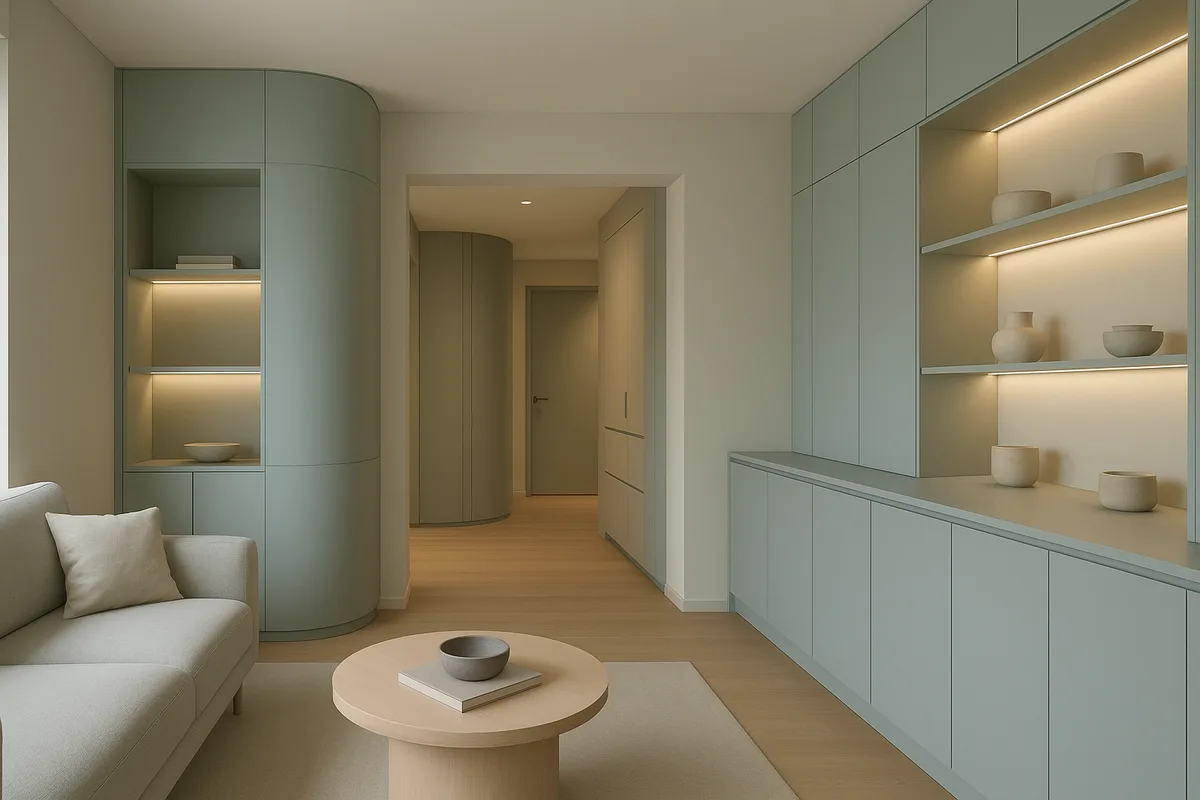
Planning Ideas for Custom Home Spaces
Prepare room photos, approximate measurements, and fixed-condition notes so Roomidea can understand your space before an estimate review.
Choose the closest room or product type
Open the category that best matches your project and use the notes as a starting point before preparing an estimate request.
Before starting a free estimate, it is helpful to share photos, approximate measurements, and any fixed conditions in the room. These can include outlets, switches, plumbing, vents, electrical panels, utility devices, attic access, balcony access, service openings, ceiling bulkheads, or any area that should not be blocked.
These details do not need to be solved before you contact Roomidea. They simply help us understand what needs to stay accessible, what can be covered, and where a special design approach may be needed.
Walk-In Closets
A walk-in closet is often planned as an L-shaped or U-shaped layout. Before choosing the storage mix, it is important to look at the doorway, wall depths, ceiling access, switches, materials, and any fixed features inside the room.
Planning ideas to consider:
- Mark any attic access, ceiling hatch, panel, vent, or service opening that must remain accessible.
- Check the wall depth beside the door after the door opens. If the wall is too shallow for hanging, that area may work better for shelves.
- Note any switches, outlets, or controls inside the closet and where they are located.
- Consider whether the closet should use an L-shaped or U-shaped layout based on the entrance and walking space.
- Plan hanging areas, shelves, soft-close drawers, baskets, pants racks, shoe storage, and jewellery trays around both storage needs and clear movement.
- Review whether LED lighting preparation or premium hardware would help daily use or display areas.
- Use upper shelves for items that do not need daily access, while keeping the main path comfortable.
Reach-In Closets
A reach-in closet often has a taller inside space than the door opening. This means the upper storage area may need a different depth from the lower shelves so that items can still be lifted in and out comfortably.
Planning ideas to consider:
- Measure the inside height, door opening height, total depth, and usable width.
- Check whether the upper shelf should be shallower than the lower storage.
- As a general planning idea, the upper shelf may need to leave open space near the front so items can be placed upward and removed more easily.
- Consider whether you are comfortable with different shelf depths and vertical panel transitions.
- Keep drawers, baskets, and pull-out accessories in locations where the closet doors will not block them.
- Check drawer clearance, door movement, and whether pull-out shoe racks or baskets can open fully.
- Think about whether the closet is mainly for hanging, folded clothing, shoes, bedding, or mixed storage.
Custom Wardrobes
Custom wardrobes can be built in, furniture-style, or planned as a storage wall for bedrooms, entries, condo rooms, or flexible spaces. Start with the room location, the storage mix, and how much of the wardrobe should be open or behind doors.
Planning ideas to consider:
- Decide whether the wardrobe is mainly for clothing, linens, shoes, bags, or mixed storage.
- Check ceiling height, wall length, baseboards, outlets, switches, and any nearby doors.
- Think about whether the storage should feel like furniture, a built-in wall, or part of the room architecture.
- Review cabinet-box and interior construction separately from doors and decorative surfaces. Depending on the application, interior choices may include white melamine-faced particleboard, decorative board, real-wood-veneer-faced particleboard, or prefinished plywood; solid wood and MDF are used where appropriate for doors or visible decorative components.
- Share photos from the room entrance and from both sides of the wall where storage may go.
Aluminum-Framed Closet Systems
Aluminum-framed closet planning is useful when the storage needs a clean, contemporary look with open sections, posts, shelves, drawers, or baskets. Urban View, Easy Life, and Modern Line references can be reviewed against current availability.
Planning ideas to consider:
- Share the wall width, ceiling height, floor condition, and photos of nearby doors or corners.
- Think about which areas should be open and which items should be stored in drawers or baskets.
- Check whether outlets, switches, vents, or access panels need to remain clear.
- Consider whether the closet should feel more open, more enclosed, or balanced between both.
Closet Accessories & Storage Features
Closet accessories can make storage more convenient when they are selected for real daily use. They should also be planned with door movement, drawer clearance, shelf depth, material direction, hardware, and lighting in mind.
Planning ideas to consider:
- Use drawers for smaller items that should stay hidden and easy to reach.
- Consider jewellery trays, pants racks, pull-out shoe racks, pull-out baskets, or divided storage where they solve a real storage problem.
- Plan accessories in locations where they can open fully without hitting doors or side panels.
- Confirm the cabinet-box or interior construction separately from door and decorative-surface selections before choosing accessories.
- For open-concept closet or cabinet sections, LED lighting preparation can be discussed as part of the design.
- Think about where lighting is useful for display, visibility, or daily access.
- Avoid filling the closet with too many specialty parts if simple shelves and hanging storage will work better.
Closet Sliding Doors
Sliding doors are fully custom, so it helps if you review the available door types and style direction before requesting an estimate. If you already know whether you prefer glass, mirror, flat panel, framed sections, single-material panels, or mixed-material panels, the estimate can usually move forward more efficiently.
Planning ideas to consider:
- Decide whether you prefer glass doors, mirror doors, flat panel doors, or a mixed panel style.
- Think about whether the door should be full-height and simple, or divided with horizontal or vertical bars.
- Choose the general frame colour and frame style you prefer.
- Review whether the panels should feel bright, reflective, private, warm, or minimal.
- Measure the opening width and height, and share photos of the floor, ceiling, side walls, and closet interior.
- Check whether drawers or pull-out accessories inside the closet will be blocked by sliding panels.
Sliding Room Dividers
Sliding room dividers are often used in condos and open-plan spaces. Ceiling bulkheads, available support, and the desired panel arrangement can affect how the system should be installed.
Planning ideas to consider:
- Check whether there is a ceiling bulkhead near the opening.
- Note whether the door would be installed under the bulkhead, up to the ceiling, or with another transition detail.
- Review whether a top-hung, floor-track, or sliding-plus-fixed-panel configuration best suits the opening.
- Share photos showing the full height from floor to ceiling, including the bulkhead and both sides of the opening.
- Think about whether the goal is privacy, light control, sound reduction, or flexible separation.
- Keep switches, vents, outlets, trim, and ceiling conditions in mind.
Wood-Style Sliding Door
Wood-style sliding doors can create a warmer look, but they may also be heavier than other sliding door options. Before choosing this direction, the existing structure and mounting condition should be reviewed.
Planning ideas to consider:
- Confirm where the door track can be supported.
- Share photos of the wall, ceiling, opening, and surrounding structure.
- In some condo conditions, side-wall mounting may not provide enough support for a heavier door.
- Consider whether ceiling support, structural blocking, or another door type is more appropriate.
- Choose a wood-style tone that works with the floor, wall colour, and nearby furniture.
- Keep the door weight, movement, and daily use in mind before finalizing the style.
Traditional Kitchen Cabinets
Traditional kitchen planning can range from restrained classic cabinetry to highly detailed architectural compositions. Choose the visual direction first, then coordinate the room, storage, appliances, and project specification.
Planning ideas to consider:
- Share photos of the current kitchen, ceiling, windows, plumbing, and appliance locations.
- Note which appliances are staying, moving, or still undecided.
- Think about the preferred level of profile, crown, glass, and architectural detail without treating Traditional as a fixed price tier.
- Review pantry storage, cooking zones, cleaning zones, and daily prep areas before finalizing door and decorative details.
Modern Kitchen Cabinets
Modern and contemporary kitchen cabinets use clean lines, minimal ornament, and streamlined surfaces. Planning still begins with workflow, appliance clearances, and fixed room conditions rather than a presumed budget level.
Planning ideas to consider:
- Mark appliance locations, plumbing, vents, outlets, switches, and ceiling bulkheads.
- Think about whether the kitchen should feel minimal, warm, bright, or high-contrast.
- Plan drawers, tall storage, pantry zones, pull-out pantry options, and waste storage around daily use.
- Share photos from several angles so the layout can be reviewed clearly.
Transitional Kitchen Cabinets
Transitional kitchen planning establishes a deliberate balance between traditional character and modern simplicity. Confirm how classic or modern the composition should feel before choosing profiles, finishes, and supporting details.
Planning ideas to consider:
- Collect inspiration showing the preferred classic–modern balance, colour, contrast, and cabinet profile.
- Share appliance plans, island needs, pantry needs, countertop or waterfall detail ideas, and any fixed plumbing or vent locations.
- Shaker and narrow-Shaker are common starting points, but Shaker is not exclusive to Transitional design.
- Keep storage function clear so the look does not make the kitchen harder to use.
Kitchen Storage Accessories
Kitchen storage accessories can improve daily function when they are planned around real habits. The goal is to make common items easier to reach, reduce clutter, and support the way the kitchen is used.
Planning ideas to consider:
- Consider pull-out pantry storage for food items, small appliances, or narrow spaces.
- Use corner carousel solutions where corner access is difficult.
- Consider waste pull-outs, inner drawers, and organizers only where they improve access or daily workflow.
- Keep cooking tools, cleaning supplies, food storage, and prep items close to the right zones.
- Review cabinet-box and interior construction separately from doors and decorative surfaces.
- Use Cabinetry Options for shared hinge, drawer-motion, specialty-motion, and integrated-lighting details.
- Avoid adding accessories that reduce useful space without solving a real problem.
Home Office Cabinetry
Home office cabinetry should support the way the room is used for work, storage, display, books, files, and equipment. Start by identifying what needs to stay visible and what should be hidden.
Planning ideas to consider:
- Measure the wall, desk area, outlets, windows, and any baseboard or trim details.
- Think about files, books, printer space, display shelves, closed storage, and everyday work items.
- Keep chair movement, monitor position, and walking space comfortable.
- Share photos of the full wall, nearby room conditions, outlet locations, and any equipment that needs access.
TV Walls & Entertainment Units
A TV wall or entertainment unit should balance viewing comfort, storage, display, hidden storage, and equipment access. Planning is easier when the TV size, seating position, outlet locations, and equipment needs are clear.
Planning ideas to consider:
- Confirm TV size, viewing height, seating position, and equipment needs.
- Note outlets, cable locations, wall width, windows, fireplaces, and nearby doors.
- Decide what should be open display and what should be behind doors.
- Think about ventilation, wire paths, remote-control access, and service access for equipment that may need attention later.
Laundry Room Cabinets
Laundry room cabinets need to work around appliances, plumbing, cleaning supplies, and tight movement. Start with the fixed conditions before choosing cabinet storage.
Planning ideas to consider:
- Share appliance sizes, plumbing locations, outlets, vents, and any utility access points.
- Think about detergent storage, hanging space, folding space, and items that should stay hidden.
- Keep washer and dryer access, door swing, and walking space clear.
- Mark anything that should not be blocked or covered, including shut-off valves, cleanouts, panels, and service openings.
Bathroom Vanities & Medicine Cabinets
Bathroom vanity and medicine cabinet planning should start with daily routines, plumbing, mirror needs, lighting, and storage access. Small details can affect comfort in a compact space.
Planning ideas to consider:
- Share the vanity width, wall height, plumbing location, outlets, and light locations.
- Think about what should be in drawers, behind mirrors, or on open shelves.
- Check door swing, drawer clearance, and nearby toilet or shower space.
- Keep daily items, medicine storage, grooming tools, and cleaning supplies easy to reach without crowding the counter.
Murphy Beds & Wall Beds
A Murphy bed or wall bed integrated with cabinetry can help a flexible room support both storage and sleeping needs. The wall, floor, ceiling, surrounding storage, and daily clearance should be reviewed early.
Planning ideas to consider:
- Measure the room, wall width, ceiling height, and clear floor area in front of the bed.
- Share photos of outlets, switches, windows, baseboards, and nearby doors.
- Think about whether the room is mainly an office, guest room, hobby room, or mixed-use space.
- Keep the open bed position, walking path, and storage access in mind.
Mudroom Cabinets & Storage
Mudroom cabinets and storage should make everyday entry organization easier. Plan around coats, shoes, bags, benches, hooks, tall cabinets, utility items, cleaning storage, doors, and the traffic path through the space.
Planning ideas to consider:
- List what needs to be stored daily, seasonally, and out of sight.
- Measure the entry wall, nearby doors, floor space, and any switches or outlets.
- Think about whether a bench, hooks, cubbies, drawers, or tall cabinets would help most.
- Keep wet shoes, school bags, pet items, cleaning supplies, and utility storage in mind if they are part of the routine.
Ready to Prepare Project Details?
Use the estimate form when you have a product direction, room notes, rough dimensions, photos, or timing context ready for review.